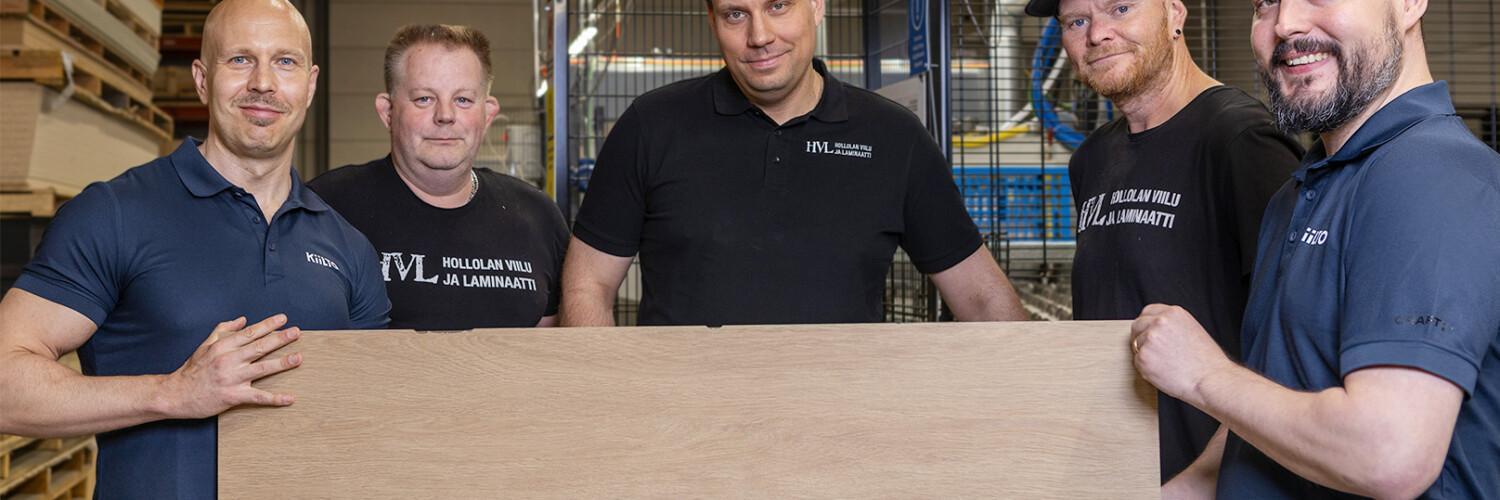
Every year, large volumes of veneers, laminates and panel materials pass through the production lines at Hollolan Viilu ja Laminaatti (HVL). As customer expectations continue to rise and material combinations become increasingly diverse, adhesive solutions must evolve alongside them. Long-term collaboration between HVL and Kiilto has led to a new adhesive solution that has been developed, tested and validated in a real production environment.
Veneering and lamination require extensive material expertise
HVL is Finland’s leading veneer processor and a trusted supplier of laminated products. Operating from two facilities in southern Finland, the company produces veneer sheets, veneer-faced panels and laminated products for a wide range of industrial customers.
The company’s customers range from small specialist manufacturers to large companies in the door and window, furniture, construction, timber and marine industries. This diversity is reflected in the materials HVL works with every day: more than 30 wood species, around 40 engineered veneers, as well as a wide range of dyed and treated veneer materials.
Even within a single wood species, customer requirements can vary considerably. In oak veneers, for example, factors such as grain pattern, colour tone and overall appearance play a major role in material selection.
“Customer focus is at the heart of everything we do. Every customer is equally important to us, whether it’s a small niche manufacturer or a large publicly listed company. We tailor our products to each customer’s needs and, when necessary, draw on our extensive network of specialised partners to deliver the right solution,” says Jukka Vuoriheimo, CEO of HVL.
Real production environments drive adhesive development
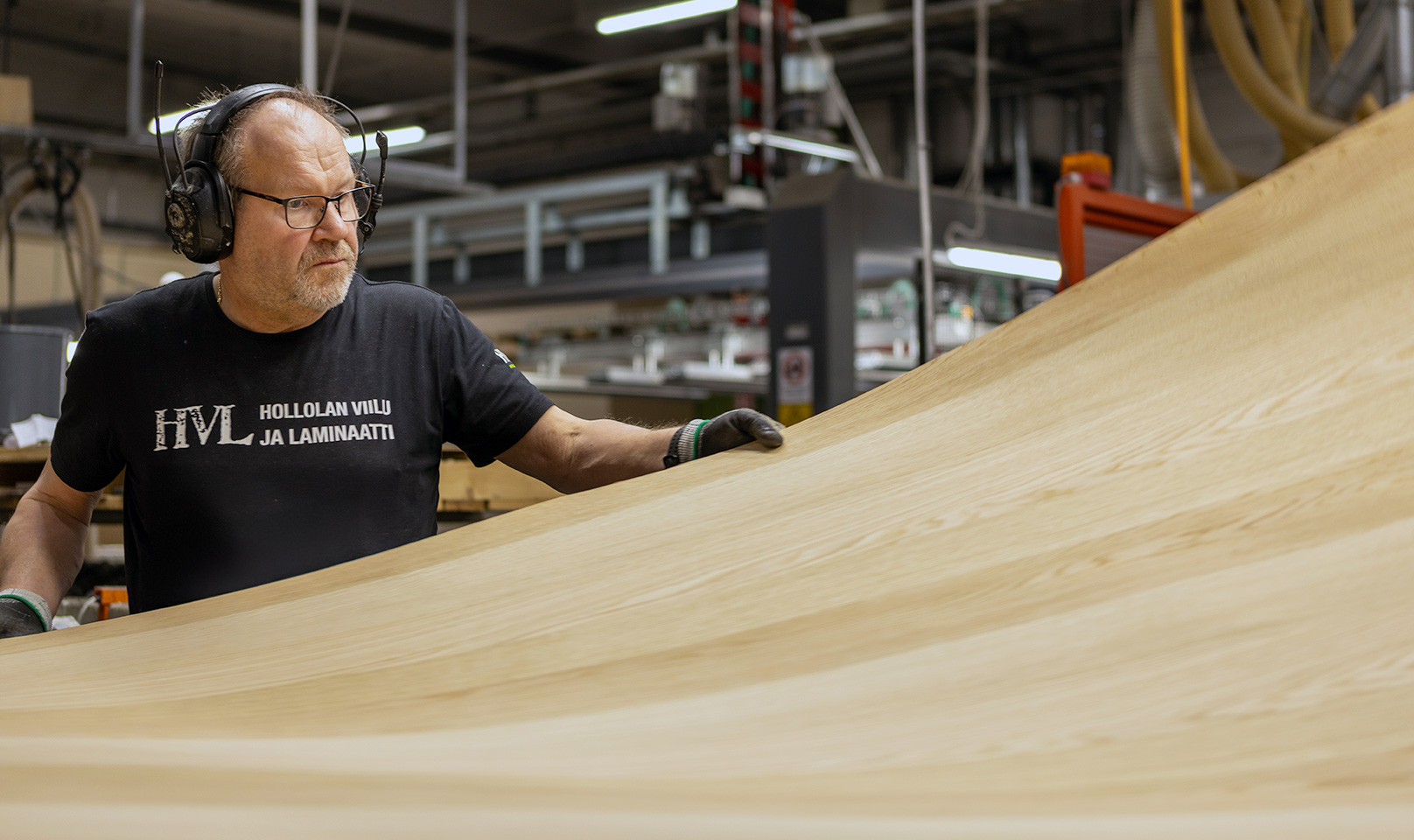
In wood veneering, where the visual quality of the finished product is critical, the adhesive must perform flawlessly – and remain virtually invisible. HVL has relied on Kiilto’s PVAc adhesives for nearly two decades.
Over the course of the partnership, several adhesive solutions have been tested and developed to meet changing production requirements. Today’s solutions are built on years of practical experience gained on the production floor.
According to Vuoriheimo, one of the greatest strengths of the collaboration is the willingness to tackle challenges together.
“Whenever we’ve encountered a challenge in our bonding process, Kiilto has been genuinely interested in finding a solution. They’ve always wanted us to succeed in our production process,” he says.
Testing new solutions under real production conditions has been a key part of the collaboration from the beginning.
“We’ve had the opportunity to test solutions at an early stage in a real production environment, which has provided valuable experience and development data for our team,”says Jukka Jokela, R&D Manager at Kiilto.
That commitment to continuous development has delivered tangible results over the years.
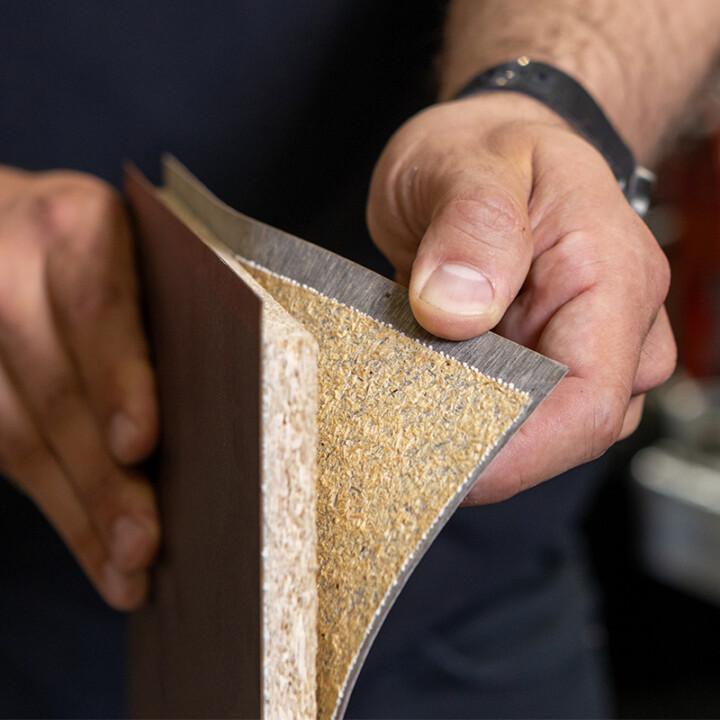
“Kiilto has carried out development work systematically and tested solutions in practice. As a result, we’ve been able to find solutions that genuinely work in our production environment,” says Vuoriheimo.
Kiilto Pro WRX 3072 solves discolouration challenges in veneering
Every wood species has its own chemical characteristics that influence how adhesives behave. In tannin-rich woods such as oak, ash and elm, traditional acidic D3-class adhesives can cause unwanted discolouration.
This challenge led to the development of the pH-neutral Kiilto Pro WRX adhesive range, which successfully eliminated the discolouration issue. However, based on practical experience gained in production, development work continued. In dark veneers, the white filler used in the original formulation could occasionally become visible if the adhesive penetrated through the veneer.
The result was Kiilto Pro WRX 3072, a fully transparent adhesive that performs equally well with both light and dark veneers.
“Dark wood species are very popular at the moment. If adhesive penetrates through the veneer to the surface, it can become visible during staining, lacquering or other finishing processes. We haven’t encountered these kinds of issues with Kiilto Pro WRX 3072, and we’ve now been using it in production for several months,” says Vuoriheimo.
The practical experience gained from HVL’s production environment has also provided valuable input for Kiilto’s product development work.
“Through this collaboration, we’ve gained important insights into how adhesives perform in real veneering applications and what properties matter the most in practice. That knowledge has helped guide our development work,” Jokela says.
Testing adhesive performance in demanding conditions
The performance of new adhesive solutions is also evaluated through extensive testing. Bonded panels are exposed to temperature and humidity cycles designed to simulate demanding transportation and storage conditions.
In these tests, Kiilto Pro WRX adhesives have demonstrated excellent performance. In several tests, the panel material itself failed before the adhesive bond, indicating a highly durable bond under the tested conditions.
“We can expose bonded panels to conditions that reflect the stresses they may encounter during transportation and use. For example, we can simulate the hot and extremely humid conditions inside a shipping container transported by sea,”says Juha Mikkonen, Business Development Manager at Kiilto.
The next phase of the collaboration involves tensile strength testing to determine the optimal process parameters for HVL’s production environment. The goal is to find the right balance between bond strength and production efficiency.
“We’re working to optimise HVL’s production line to find the minimum pressing time that works for their process. The critical thing is that the solution works in their specific production environment,” says Mikkonen.
Sustainability is becoming an increasingly important purchasing criterion
Alongside quality and aesthetics, customers are paying increasing attention to the origin and environmental impact of materials. HVL relies heavily on locally sourced materials, and FSC certification is available for almost all veneer species in its portfolio.
Adhesive selection can also support customers’ sustainability goals and help reduce the environmental footprint of the finished product. Kiilto Pro WRX 3072 already contains a bio-based binder component, and the bio-based content can be adjusted according to application-specific requirements.
“Customers are increasingly interested in where materials come from and what kind of carbon footprint they carry. Sustainability has definitely become a competitive advantage for us,” says Vuoriheimo.
A shared commitment to continuous improvement
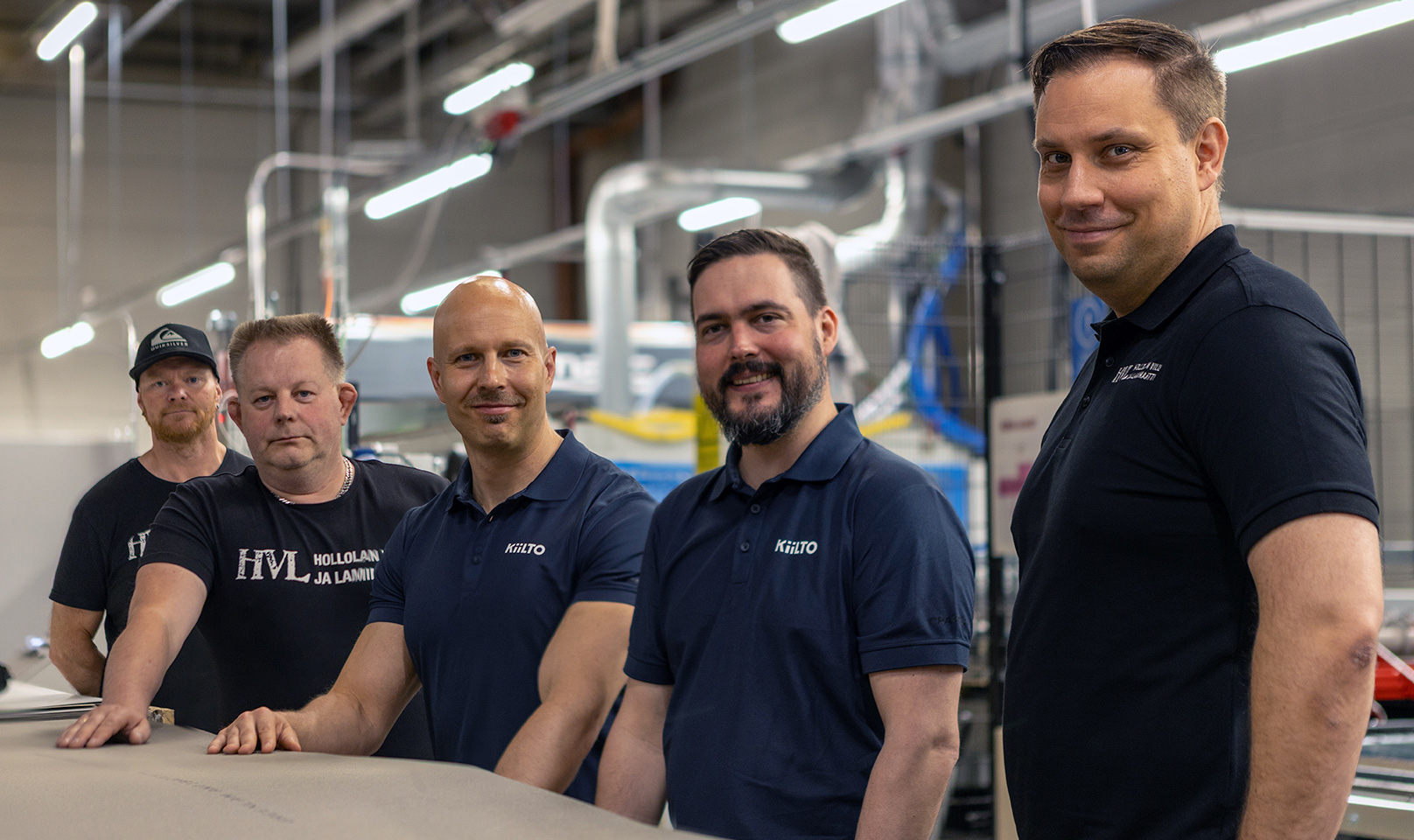
Kiilto’s goal is to understand how its adhesive solutions perform in real production environments and how they can be further developed to meet changing customer needs. Keeping development projects moving forward requires close collaboration and regular communication between both parties.
“Companies have plenty of things to focus on besides adhesives,” says Mikkonen. “Our job is to keep things moving forward.”
The partnership benefits both sides. Kiilto gains valuable insights from real production environments that cannot be replicated in a laboratory, while HVL gains access to tailored adhesive solutions designed around its specific production requirements.
“The greatest value of this collaboration is the trust we have built over the years. Whenever we face a challenge, we know we can work through it together,” says Vuoriheimo.
| Hollolan Viilu ja Laminaatti Oy Founded in 1994, Hollolan Viilu ja Laminaatti (HVL) has been using Kiilto PVAc adhesives for nearly two decades. The company is Finland’s leading veneer processor, employing 22 people and operating two production facilities in Hollola, Finland. |